The EU's new €3 parcel duty, explained for Etsy & Amazon sellers
From 1 July 2026 the EU ended its €150 duty-free exemption and now charges €3 per product category on low-value parcels from non-EU sellers. Here's what it actually means for your orders.
More compliance, just what we all needed. Since 1 July there's a new €3 customs charge on parcels under €150 entering the EU, supposedly to combat Shein and Temu. Call it what it is: more red tape for sellers. And if you ship to EU customers and haven't changed anything since June, this post is for you. Two weeks in, sellers who haven't caught up are already seeing the consequences: buyers hit with surprise charges at the door, and parcels sitting in customs, or coming back.
Here's the short version, then the details that actually matter.
What changed on 1 July 2026
For years, parcels worth under €150 entered the EU duty-free under the so-called de minimis exemption. That exemption is now gone. In its place: a flat €3 customs duty on low-value parcels sent from non-EU sellers, live since 1 July 2026. This isn't blog-rumour: the Council formally agreed it in December 2025, and the European Commission confirmed the details two days before it went live.
Whatever the "Shein and Temu tax" framing suggests, it applies to every parcel from a non-EU seller, including a single handmade necklace posted from Sheffield to a buyer in Lyon. If you're a UK, US, or other non-EU seller shipping into the EU, this is your tax now too.
And to be clear about what it isn't: this is not just a €3 price bump. It's a paperwork change. The fee is the visible part; the customs data behind it is what decides whether your parcel sails through or gets stuck.
The stacking rule: why it's not "€3 per box"
This is the part almost every news article gets wrong, and the one that actually changes your maths.
The €3 is charged per product category (tariff heading) in a parcel, not once per parcel. That's straight from the Commission's own guidance and legal text, not our reading between the lines.
- A buyer orders three of the same t-shirt: one category, so €3.
- A buyer orders a t-shirt, a pair of sunglasses and a wallet: three categories, so €9.
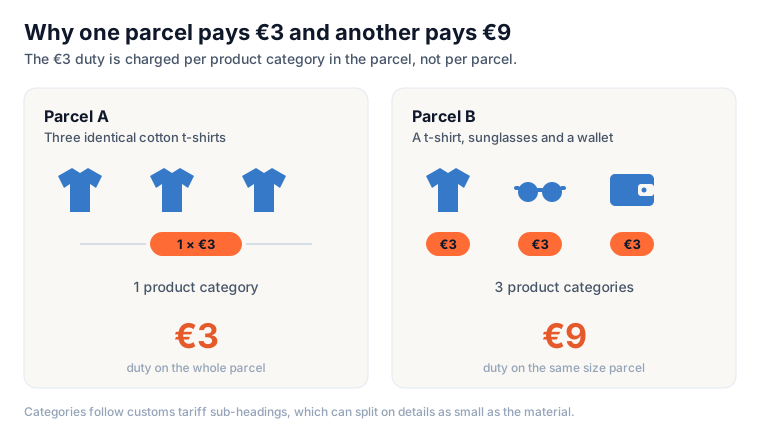
And "category" is narrower than you'd hope. Tariff sub-headings split on details like material, so even subtle variations of the same product, say a cotton and a polyester version of one design, can land in different categories. Another line on the customs form, another €3.
So your mixed-basket orders, the good ones where someone falls in love with your shop and buys across your range, are exactly the orders that attract the biggest fees.
A worked example: a UK jewellery maker sends a buyer in France a €25 necklace and a €15 pair of earrings in one parcel. Two tariff headings means 2 × €3 = €6 of duty on a €40 order. That's a 15% hit that either your buyer swallows at the door or you price in. Before 1 July, it was zero.
The carrier trap: the €3 is rarely just €3
Here's where it gets genuinely annoying. What your buyer actually pays depends on how the parcel ships:
- DDP (Delivered Duty Paid): you pay the duty upfront through your carrier or the marketplace. The buyer sees one price and gets no surprises.
- DDU (Delivered Duty Unpaid): the carrier pays the duty at the border, then charges your buyer the duty plus a handling fee for the privilege of collecting it. An Post in Ireland, for example, charges a €6.95 customs administration fee on top of whatever's owed.
So a DDU parcel with €6 of duty can land on your buyer's doorstep with a €13 ransom note attached. They didn't budget for it, they blame you, and that's the one-star review (or the refused parcel) right there.
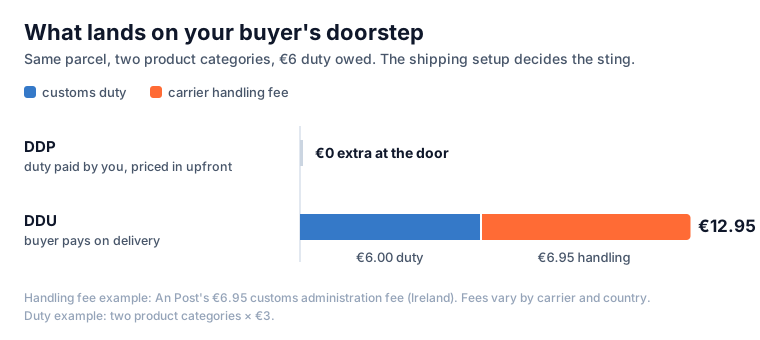
If you take one thing from this section: find out which of these your current shipping setup actually is. Many small sellers honestly don't know.
Why parcels are getting held and returned right now
Two weeks in, postal operators including An Post and Royal Mail are reporting customs processing delays, and parcels from smaller non-EU retailers are getting held or sent back. The pattern isn't sellers refusing to pay €3. It's paperwork: missing or vague customs descriptions, no per-item values, wrong or missing category information.
Under the new regime, every item in the parcel needs to be properly declared so customs can work out how many €3 charges apply. "Handmade gift" with a lumped value doesn't cut it anymore. Sloppy declarations used to slide through under the exemption; now they're exactly what the automated checks flag.
What to actually do about it
Honest, practical, in rough priority order:
- Audit your bestsellers' customs categories. For the products that make up most of your EU orders, know their correct commodity (HS) codes and use them consistently on customs forms. This is the single biggest thing that keeps parcels moving.
- Declare per item, accurately. Real descriptions, real per-item values. Boring, but it's the difference between "delivered" and "held at customs."
- Decide who pays, on purpose. If you sell mainly through Etsy or Amazon, check what the marketplace handles for you and what it doesn't. If you ship your own orders, ask your carrier about DDP options so the buyer isn't ambushed at the door.
- Tell your EU buyers. Update your shop announcement, FAQs and shipping policy so nobody's surprised. A sentence like "EU orders may attract a small customs charge; here's how we handle it" saves you the angry message later.
- If EU sales are a big slice of your business, holding stock inside the EU (or EU-based fulfilment) makes the whole problem disappear, because parcels moving within the EU aren't imports. It's a bigger step, but worth the maths if you're posting into the EU every week.
How long this lasts
This flat-fee regime is officially interim, running to 1 July 2028, when it's due to be replaced by standard per-item tariffs once the EU's new customs IT system is ready. So no, it won't blow over. This is the reality for at least the next two years, and "may be extended" is doing some heavy lifting in the official wording.
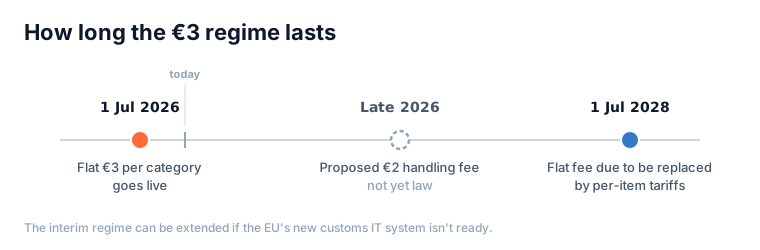
One more thing on the horizon: a separate €2 handling fee per parcel is being negotiated in Brussels. It's not law yet (expected later in 2026), but it tells you the direction of travel. We'll update this post when it moves.
The bigger picture
The €3 duty and GPSR are the same story told twice: the EU is raising the cost, and above all the paperwork, of selling in from outside. A parcel can now get flagged at the border for customs reasons and for product-safety reasons at the same time: no proper declaration on one side, no EU Responsible Person or safety documentation on the other.
You can't opt out of the €3. But the documentation half of the problem is one you can fix: the technical file, risk assessment and labelling the GPSR expects you to have are exactly what GPSRHub generates for you in minutes instead of a lost weekend. If EU buyers matter to your shop, that's the half worth fixing first.
Quick FAQ
Is the €3 duty per parcel or per item? Per product category (tariff heading) in the parcel. Three identical mugs = €3. A mug, a candle and a print = €9.
Do small Etsy sellers have to pay it? Yes. It applies to every non-EU seller shipping into the EU, regardless of size.
When did it start? 1 July 2026.
Will it change? It's an interim regime until 1 July 2028 (extendable), and a separate €2 handling fee is proposed but not yet law.
Sources
- Council of the EU: customs duty on small parcels agreed as of 1 July 2026 (12 December 2025)
- European Commission: €3 customs duty for low-value parcels (29 June 2026)
- DG TAXUD: guidance and legal text on the temporary flat fee, applying until 1 July 2028 (8 June 2026)
- An Post: customs charges and the €6.95 administration fee
Need your GPSR compliance handled for you?
GPSRHub generates authority-grade Technical Files, Risk Assessments, and Declarations of Conformity for Etsy & Amazon sellers, and can act as your EU Responsible Person.
See plans